


CARRY
Carry-on size guide:
the one number that gets you on the plane.
Every airline limit, tightest first. Plus the size that clears almost all of them — so you can stop looking this up.
- 55 × 40 × 20cm clears the large majority of airlines worldwide. Build to that and you rarely think about this again.
- Weight catches more people than size. Several major carriers allow only 5 to 7kg, and nobody measures a bag by weight at home.
- The limits haven't changed. The enforcement has — a bag that flew for years is now being measured.
- Published dimensions include handles and wheels, and sizers are sometimes tighter than the published figure.
- If you're gate-checked anyway, the fee is usually $75 or more, asked for at the worst possible moment.
The size that clears almost everything
Nearly every full-service carrier in Europe and Asia lands on or above this. It's also close to IATA's own recommendation, which airlines are free to ignore and frequently do.
The exceptions are worth knowing rather than fearing. A handful of carriers go tighter on one dimension — Aer Lingus at 48 × 33 × 20 for its free bag, Air Transat at 51 × 40 × 23. And US carriers publish 56 × 36 × 23, which is deeper than 20cm but narrower than 40cm.
If your bag is 55 × 40 × 20 or under, you'll clear the tight ones on depth and the American ones on width. That's the whole trick.
Weight catches more people than size
This is the part every size guide skips, and it's where most of the money changes hands.
Air China, China Southern, Bangkok Airways and TUI fly Belgium allow 5kg. Cathay, Emirates, Etihad, EVA, Garuda, Qatar, Singapore, Air India, Malaysia and Philippine sit at 7kg. Seven kilograms is a small bag, a laptop, a pair of shoes and almost nothing else.
Meanwhile Delta, United, American, Alaska, JetBlue, Southwest, Spirit and easyJet publish no weight limit at all.
So the same physical bag is legal on one flight and thirty per cent overweight on the next — and the airlines with the strictest weight limits are frequently the long-haul ones, where you're carrying most.
| Airline | Size | Weight |
|---|---|---|
| Air China | 55 × 40 × 20 | 5kg |
| China Southern | 115cm total | 5kg |
| Bangkok Airways | 56 × 36 × 23 | 5kg |
| TUI fly Belgium | 55 × 40 × 20 | 5kg |
| Condor | 55 × 40 × 20 | 6kg |
| Aer Lingus (free bag) | 48 × 33 × 20 | 7kg |
| AirAsia | 56 × 36 × 23 | 7kg |
| Emirates | 55 × 38 × 20 | 7kg |
| Cathay Pacific | 56 × 36 × 23 | 7kg |
| Qatar Airways | 115cm total | 7kg |
| Singapore Airlines | 115cm total | 7kg |
| Air New Zealand | 57 × 37 × 24 | 7kg |
| Airline | Size | Weight |
|---|---|---|
| British Airways | 56 × 45 × 25 | 23kg |
| easyJet (large) | 56 × 45 × 25 | none |
| Spirit | 56 × 46 × 25 | none |
| Southwest | 61 × 40.5 × 25 | none |
| Frontier | 61 × 40.5 × 25 | 15.8kg |
| American | 56 × 36 × 23 | none |
| Delta | 56 × 35 × 23 | none |
| United | 56 × 35 × 22 | none |
| Alaska | 56 × 36 × 23 | none |
| JetBlue | 56 × 36 × 23 | none |
| Air Canada | 55 × 40 × 23 | 10kg |
| Lufthansa | 55 × 40 × 23 | 8kg |
| Air France | 55 × 35 × 25 | 12kg |
| KLM | 55 × 35 × 25 | 12kg |
| Turkish | 55 × 40 × 23 | 8kg |
| Korean Air | 55 × 40 × 20 | 10kg |
| Japan Airlines | 55 × 40 × 25 | 10kg |
| ANA | 55 × 40 × 25 | 10kg |
| Qantas | 56 × 36 × 23 | 7kg |
| Ryanair | 55 × 40 × 20 | 10kg |
Why a bag that fits still gets gate-checked
Because measurement is no longer the mechanism. American has started removing the metal sizers from gates, on the grounds that they cause friction and delays — which means the frame that used to settle arguments has gone, and a gate agent's judgment has taken its place.
That agent has a few minutes to board a full aircraft. When the bins fill, bags get checked, and whether yours was technically legal stops being the relevant question.
The rules didn't change. Somebody just started measuring.
Two more things worth knowing.
Published dimensions include handles and wheels. Nearly every airline says so and nearly every traveller measures the case body.
And sizers are occasionally tighter than the published figure. A Flair passenger had a suitcase built precisely to spec and still failed the frame at Edmonton. Ryanair travellers report the same, plus wheels crossing a painted line inside the sizer rather than the actual edge.
Which is the whole argument for building under the limit rather than to it. A bag at 55 × 40 × 20 has margin. A bag at exactly the maximum has an argument.

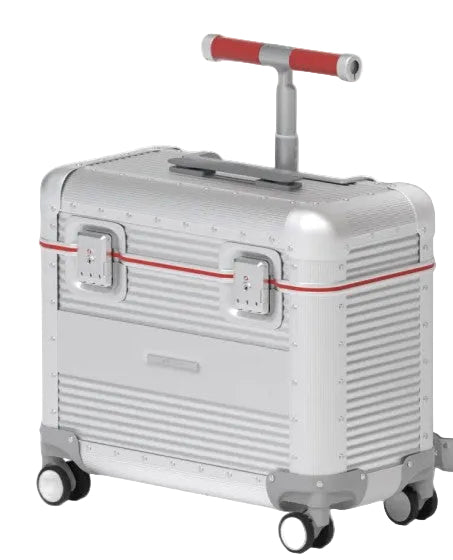
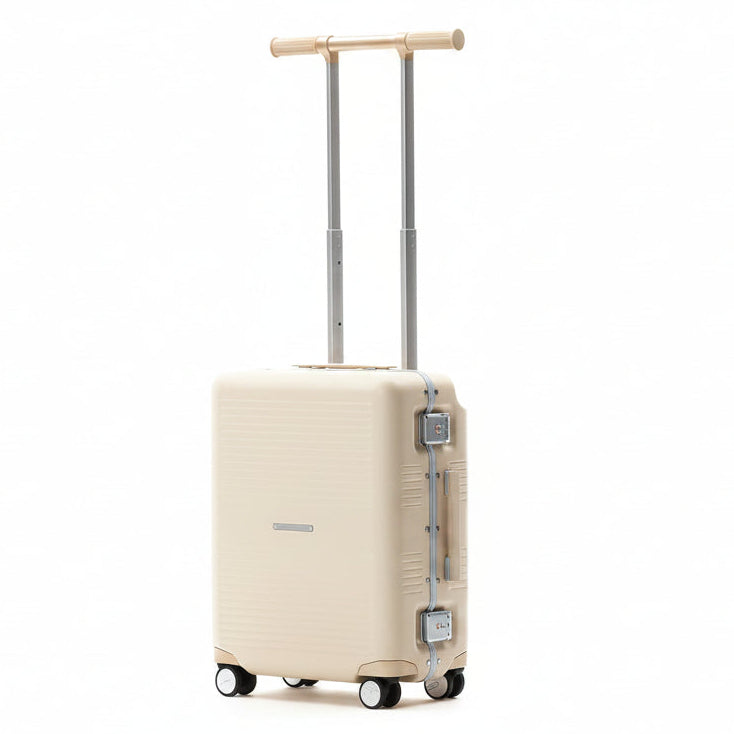
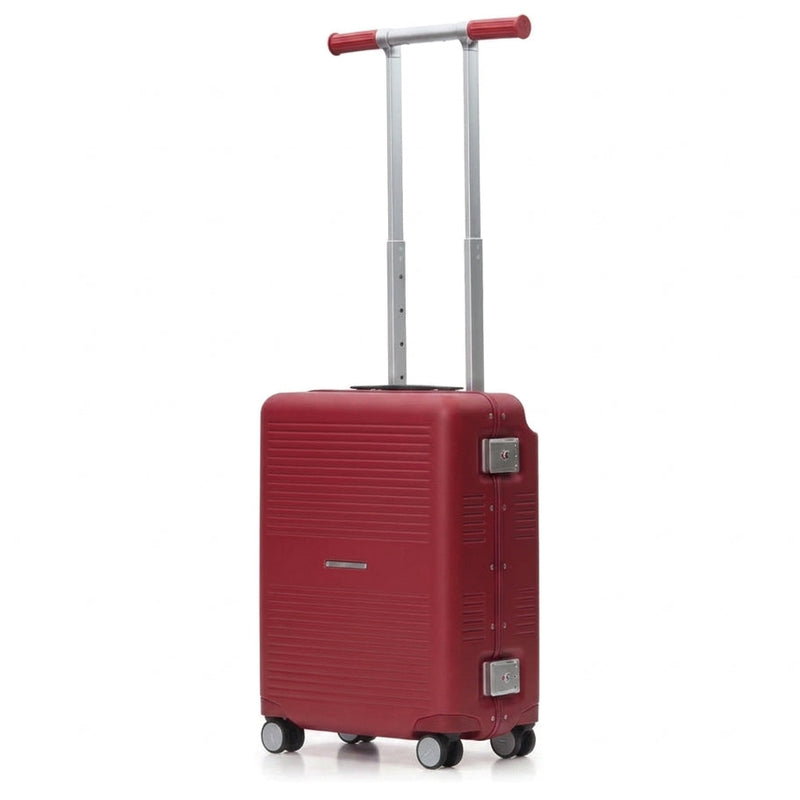
TIME OUT × RAWROW Cabin Trunk 20" — 37L, 4.1kg, Red
Measured with the wheels and the handle, because that's how they measure it at the gate.
If you get stopped anyway
Straighten the handle and the wheels before the sizer. A retracted handle and squared wheels are frequently the entire difference, and the reported failures often come from a part crossing a warning line rather than the frame.
Take the heavy things out and wear them. A coat with a laptop in it is not luggage.
Ask them to check it free to your final destination. It's often granted when the bins are genuinely full, because the airline needs the bag gone either way.
Then photograph the bag in the sizer. If you're charged and the bag fits, that photograph is the only thing that gets the fee back.
The questions we get
What is the standard carry-on size?
There is no single standard. 55 × 40 × 20cm clears the largest number of airlines, while most US carriers publish 22 × 14 × 9 inches, which is 56 × 36 × 23cm. The FAA sets no carry-on standard — each airline sets its own.
Does carry-on size include wheels and handles?
Yes. Almost every airline states that published dimensions include wheels, handles and side pockets. Measure the widest point of the packed bag, not the case body.
What size carry-on fits all airlines?
No single size fits every airline, because a few carriers go tighter on one dimension. 55 × 40 × 20cm is inside the published allowance of the large majority.
How strict are airlines about carry-on size in 2026?
Stricter than they were, without the rules changing. Enforcement has increased and several airlines have moved from measuring bags to agent judgment, which makes outcomes less predictable rather than more.
How much does it cost if my carry-on is too big?
Commonly $75 or more, charged at the gate in the minutes before boarding. Exact fees vary by airline and route.
Which airlines have the strictest carry-on weight limits?
Air China, China Southern, Bangkok Airways and TUI fly Belgium allow 5kg. Cathay Pacific, Emirates, Etihad, EVA Air, Garuda, Qatar, Singapore, Air India, Malaysia Airlines and Philippine Airlines allow 7kg.
Do US airlines have a carry-on weight limit?
Most do not. American, Delta, United, Alaska, JetBlue, Southwest and Spirit publish no weight limit for cabin bags, only a size limit.
Is a 24-inch suitcase carry-on size?
No. Many airlines cap the longest side at 22 inches, and some luggage is sold as "carry-on size" at 24 inches. Check the published figure for your airline rather than the label on the bag.
Can I take liquids in my carry-on?
Containers must be 100ml or less in most jurisdictions, in a single transparent bag. A 350ml bottle goes in the hold regardless of how much is left in it.
The cheapest bag is the one that never gets measured.
Note: We check these figures quarterly. One email when something moves that would affect you.



Airline policies change without notice. Confirm with your carrier before you fly. Last checked July 2026.